Im Not a Hot Mess More Like Red Again Slow Meme
By Denise Foley

With her long dark hair flying, Saorla Meenagh, 10, (pictured above) can execute a perfect switch leap, 1 leg out, one tucked under, her arms glued to her sides in archetype Irish step-dancing mode. Saorla, whose blue eyes, white peel, and sprinkle of freckles helped win her a modeling contract with a New York agency—on hold until her braces come off —likewise plays softball and Gaelic football, a soccer-like game her father, Seamus, a contractor, enjoyed when he was growing up in County Tyrone, Northern Ireland.
When asked her position on the team, Saorla wiggles in her seat at the family unit's dining room table. "I don't know—random positions," she says, as her mother, Kerri, a pediatric nurse practitioner quietly pushes her daughter'southward bare foot off the table where it has wandered for what may be the tenth time in half an 60 minutes. During that time, Saorla's deportment are as scattered as puddle balls in a break. She sits on her knees, then jiggles, then rocks, then circles photos in a stack of nutrient magazines with a pen, turning off the Tv set, turning upwards the Boob tube, turning down the Goggle box, and making function of a bracelet on a Rainbow Loom earlier she finally loses interest. She rarely finishes a task and being with her can be as disconcerting equally watching television with someone pressing the channel changer every ten seconds.
 Forth with a souvenir for math and a love for Gaelic sports, Saorla has inherited something else from her father: attention deficit hyperactivity disorder, ADHD. People just meeting her notice her adorably sugariness, if quirky. Only if she's not on her medication—which she isn't at the moment because we met at her family unit's abode in a Philadelphia suburb during the summertime—she is an exhausting ball of boundless energy. (While she'south not at school, her mother gives her a medication holiday in club to boost her appetite, help her gain weight and grow, all things Vyvance interferes with.) "When we had her tested they said that in twenty years she was the most hyperactive child they e'er tested," says Meenagh, gently removing that errant foot from the tabular array even so again.
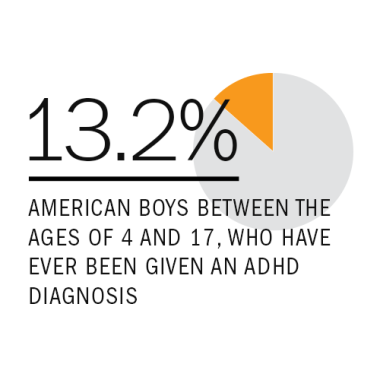
But Saorla's perpetual move isn't what concerns Meenagh the nigh. Beingness fidgety and easily distracted are ii of the most common and recognized symptoms of ADHD, often leading to poor performance in school, the well-nigh recognized fallout of the status. Only the 5% to 11% of American children 4 to 17 years of age who are diagnosed with the disorder—the numbers are up for debate depending on whom you talk to—as well face a lifetime of increased risk for accidents, teen pregnancy, drug and alcohol corruption, smoking, and fifty-fifty dying prematurely. Overall, boys (13.2%) are more likely than girls (v.half-dozen%) to be given an ADHD diagnosis.
It's the fear for her child'southward time to come that makes Meenagh bristle when she hears someone—family unit, friends, strangers, even scientists—say that ADHD doesn't be, that the symptoms are caused by poor parenting, food additives, or 21st century life in the fast lane, lack of concrete activity, or that they're just kids existence kids, albeit less manageable than most. "A lot of people don't believe in information technology," she says. "I recollect that'due south because they've never experienced information technology firsthand."
To those naysayers, C. Keith Connors, professor emeritus of medical psychology at Duke University and creator of the Connors Rating Scales for diagnosing ADHD, says he always offers the aforementioned claiming: "Take one of these kids on a auto trip for a day and see how you feel nigh it then."

It's easy to come across why some dismiss ADHD every bit just an artifact of modern life. Afterwards all, nosotros're all on the information Autobahn. Most Americans are exposed to an boilerplate of 100,000 words a day—about the length of Mark Twain'south The Adventures of Huckleberry Finn—very little of which nosotros're able to absorb, according to a 2009 study on America's information consumption from the Academy of California, San Diego. We're as well asked from a very young age to be all the same, well-nigh motionless, except for the tapping of our fingers on the computer keys. Ours is not a order tolerant of perpetual motion or daydreaming. At some point, we're all like the dog in the Pixar movie, Up, doing one thing and then responding to the real-life equivalent of "Squirrel!"
Only ADHD isn't a disorder of the modernistic historic period. Information technology may have been first described in the medical literature in 1763 by Scottish doctor Sir Arthur Crichton, who observed patients so unable to focus that "the barking of dogs, an ill-tuned organ, or the scolding of women, are sufficient to distract patients of this description to such a degree, as well-nigh approaches to the nature of delirium." Those patients, he noted, referred to their ain symptoms, including acrimony "bordering on insanity," as "the fidgets."
The argument doesn't concord up either when ADHD's worldwide prevalence is factored in. It's plant in developing countries, where the information speed limit is slower and the requirement to be sedentary 24/7 doesn't exist.
 Nevertheless at that place's an undeniable backlash against the diagnosis. Before this year, Chicago neurologist and ADHD specialist Dr. Richard Saul published a provocatively titled volume, ADHD Does Non Exist, in which he proposes that ADHD is non an entity in itself but a cluster of symptoms that stem from more than 20 other conditions, including depression, anxiety, bi-polar disorder, and obsessive-compulsive disorder. Many of those, forth with dysfunctional behavior conditions such every bit oppositional defiant disorder, characterized by assailment, tantrums and a propensity to debate with adults, and learning disabilities such every bit dyslexia, are often diagnosed as co-illnesses with ADHD. Saul criticizes the catchall-nature of an ADHD diagnosis, which he believes corrals a lot of real atmospheric condition into 1.
Saul's theories hit home with a lot of people who are worried about statistics showing an increase in the number of ADHD diagnoses in the U.S. and the number of prescriptions filled every year for relatively powerful stimulant drugs such as Ritalin, Adderall and a host of new medications. Though these drugs are generally considered safe, they do have side furnishings, including feet—sometimes fifty-fifty paranoia—weight loss, insomnia, and growth retardation (about half an inch, which doesn't announced to be permanent). In some rare cases they can damage the heart. Since many of the drugs are ambition killers, some parents have to entice their children with small meals all day long. The side furnishings are why many children like Saorla take medication holidays during summertime months or even on the weekends. They're also why doctors and parents have to carefully weigh whether the bug a child has if he or she goes unmedicated are worth the run a risk.
How prevalent has an ADHD diagnosis become? A survey of 76,000 parents conducted by the Centers for Affliction Control (CDC) every four years estimates that one in 11 children had been diagnosed with ADHD by a health care professional, an increase of 42% betwixt 2003 and 2014. "[That number] is preposterous," says Connors, who studied and treated ADHD for fifty years earlier retiring. "That would make information technology an epidemic." (Come across a map of ADHD prescriptions in the U.S.: What'due south With ADHD in the S)
Ane possible caption for the frequency of the diagnosis is that the data drove method is imperfect. The National Survey of Children's Health is a telephone survey and the figures on ADHD are collected on the basis of the answers to ane question: "Has a medico or other health care provider ever told you that [your child] had attention deficit disorder or attending-deficit/ hyperactivity disorder, that is, ADD or ADHD?" The type of "other health care provider" isn't established. ADHD experts say information technology is frequently a pediatrician who does not spend the kind of time it takes to brand an accurate diagnosis. The gold standard of ADHD diagnosis is an analysis of questionnaires, like those Connors adult, filled out by parents, teachers and other people who interact with the kid and observe classroom behavior. Each kid can take hours to clarify.
"That's a luxury a pediatrician doesn't have," says Dr. Harold Due south. Koplewicz, Physician, who founded the NYU Written report Center and is founding president of the nonprofit Child Mind Found in New York City. 'They get seven minutes confront to face, [the physician gives] them a prescription, and and so xxx days afterwards they come back to become it renewed."
(The CDC, however, defends its figures. They say the numbers from their parent survey hold up when they're compared to their ain split up, more than scientific study looking at insurance claims and field assessments. In this example, scientists in the field do a full two.five-hour diagnostic evaluation of students for ADHD and other behave and mental health disorders in 10,000 schools across the country, says epidemiologist Susanna Visser of the CDC's National Middle on Birth Defects and Developmental Disabilities. "Nosotros come up upwardly with a like gauge—8.five to 10%," she says.)
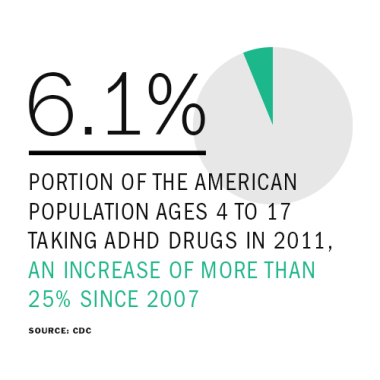
And the drug stats aren't in question. The percentage of children taking drugs jumped by more than than a quarter, from 4.8% of the population betwixt iv and 17 to half-dozen.1% between 2007 and 2011 co-ordinate to the CDC's survey. In fall 2011 and spring 2012, there was even a brief shortage of ADHD drugs, particularly generics, because the demand was outpacing the supply.
 Along with quickie diagnoses in a pediatrician'due south office, part of the problem seems to stem from a misunderstanding of ADHD symptoms and the methods used to diagnose the disorder. The diagnosis is based on a checklist, found in the "bible" of mental health, the Diagnostic and Statistical Transmission of Mental Disorders (DSM-Five), of 18 possible symptoms, whatsoever of which could describe the average child—even the boilerplate adult—some of the time. They include interim before thinking, being unable to filibuster gratification, staying motived to end a boring task, keeping potent emotions in check, remembering an assignment and how to consummate it, or planning alee.
Just three other factors play a pivotal role in determining whether a child has a disorder or is just quirky, inattentive, or high-spirited. To be diagnosed with ADHD, children must have nigh of those 18 symptoms, most of the time, in most areas of their lives, from home to school to the neighborhood playground.
"And, most important, at that place must be impairment," says leading ADHD expert Russell Barkley, PhD, clinical professor of psychiatry and pediatrics at the Medical University of South Carolina in Charleston. "They must be unable to part also equally others—and in fact, are often well below normal—in whatever of those domains."

Fourteen-year-one-time Zoe Williams "is just a fireball," says her female parent, Monnica Williams, a Louisville, Kentucky, psychologist who has five children, three of whom have been diagnosed with ADHD. "She'south the kid in the middle of the dance floor that all the other kids are watching, And she talks and talks and talks. Sometimes I have to say, 'Zoe, it's non that I don't desire to hear what you take to say, simply Mom needs a little talking timeout.'"
While kids with ADHD tin can be gregarious, their impulsiveness can create problems, often alienating others, including siblings, teachers, and classmates. They don't wait their plough, interrupt others, are easily frustrated, take wild risks, and their emotions can spill over like h2o at a rolling boil: They may be hot-headed, lash out violently, or have temper tantrums. All of this carries enormous social price in school and on the playground.
Like autism, ADHD symptoms fall along a spectrum from mild to severe, and then it's difficult to ascertain what'due south typical. But, in general, for a child with attention deficits, trying to focus on one thing is akin to trying to discern the chirping of crickets in Times Square. They're forgetful, tend to procrastinate, and are disorganized. They take a hard time putting in the time and effort to attain a goal, particularly if information technology's something similar finishing a schoolhouse project on a topic that doesn't interest them. (Paradoxically, they tin can also hyperfocus at times, confusing parents who can't sympathise why a child who can reach the sixtythursday level of Globe of Warcraft tin can't remember homework assignments or follow a simple gear up of instructions.)
Some are chronically late. "People with ADHD are blind to the futurity, which is why they never have anything done on time," says Barkley. "If you take an ADHD exercise, a 3rd of your patients are late or never testify." (Those practices unremarkably include adults; nigh ADHD symptoms persist into adulthood, though they may exist milder.)
ADHD is divided into subtypes—children but with attention problems, those with impulse control and hyperactivity issues, and a group with a combination of the two. The latter is the nearly mutual, occurring in ii-thirds to 3-quarters of people, estimates Barkley.
Children with attending problems can have any or all of these symptoms, but may non be whatsoever more fidgety than the average child. Sometimes they're labeled just ADD. On the other mitt, children who are hyperactive besides as distractible may not be able to finish moving or fifty-fifty to stop talking, including to themselves. An internal conversation for virtually people tin can become a conference call on speakerphone for a child with ADHD.
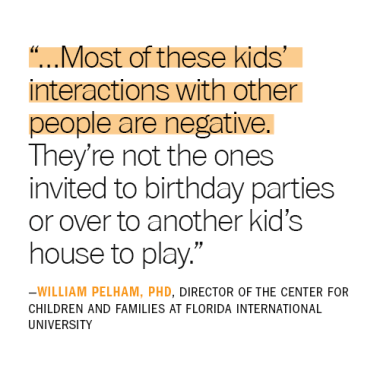
So it'southward no surprise that the boilerplate ADHD-affected child has one to ii negative interactions per minute with the people in their lives, says William Pelham, director of the Center for Children and Families at Florida International University who has authored or co-authored more than than 300 papers on ADHD. "What that means is that most of these kids' interactions with other people are negative. They're not the ones invited to birthday parties or over to another kid's house to play."
 That kind of rejection can exist damaging to a child'southward self-esteem and heartbreaking for parents. "Saorla is such a good kid, such an compassionate kid, just if she's tired, she becomes 'Hurricane Saorla,'" says Meenagh. The infinitesimal Saorla learned to walk she climbed—everything, and not skillfully. She was impulsive, fearless and, probably as a result, accident-prone. The Meenaghs once had to call the police and fire department to become Saorla, then a toddler, out of a bathroom where she had barricaded herself backside a locked door and a drawer she pulled out.
During a course visit to the zoo, Saorla, who has problem transitioning from one activity to another, aghast at moving from 1 exhibit with the remainder of the children and threw a classic "big blowout" tantrum—kicking and screaming—while her female parent hauled her away. It's non unusual, says Meenagh, for those outbursts to go on for an hr.
"I was very aware that everyone was looking at us," she says. "I was mortified, but mainly I was scared that she was going to be labeled by the other parents as a kid other kids shouldn't be friends with."
Saorla does have friends, Meenagh is quick to note, but they're non her 10-year-quondam classmates at the local 1000-8 Cosmic parochial school she attends. "She operates more than at a seven-year-old level so her friends tend to exist younger," says Meenagh. "She can be very silly—giddy to the indicate that her classmates say she'southward too lightheaded for them."
Every bit much as Meenagh frets over her kid's feelings at present, she worries fifty-fifty more about Saorla'southward future. "I've read a lot about teenage girls with ADHD, how they don't fit in socially, how they accept four to five times the rate of teen pregnancy and are iv to five times more than likely to be in car accidents. I worry well-nigh how this is going to play out."
Meenagh's fears are well-founded, says Barkley, author of Taking Charge of ADHD and several other books on raising hard children and teens. "This is a very serious disorder." He rattles off a catalog of scary statistics: "As adults, people with ADHD are five times more likely to speed and three times more than likely to have their licenses revoked than other people. They're more than likely to feel accidental injuries—burns, poisoning, traffic accidents, all kinds of trauma—than other people. In fact, having ADHD makes yous three times more probable to be dead past the age of 45."
Barkley is aware that he sounds alarmist, but he has practiced reason. ADHD struck close to home, and with tragic consequences. "I lost my twin brother, Ron, to it," he says. His blood brother was killed in a one-car accident after drinking. He was not wearing a seatbelt. "This isn't just professional person for me, it's personal."
To say that ADHD is sometimes misdiagnosed—fifty-fifty over-diagnosed—is probable true, say many experts. Merely to say that it doesn't exist, as some critics merits, is "similar maxim the world is apartment," says Edward Hallowell, a psychiatrist who treats ADHD at The Hallowell Centers in Cambridge, MA, and New York City and who has ADHD himself. "Those days are over. Today we have brain scans, genetic studies, twin studies that show that this is a highly inherited neurobiological disorder, not some made-upwards status." Most of the doctors who treat people with ADHD agree that of course the condition exists, fifty-fifty if others similar Richard Saul dispute information technology.
Sophisticated neuroimaging technology has immune usa to see what Crichton's xviiithursday century patients called "the fidgets" in the encephalon. Today, scientists believe most ADHD tin can be traced to a malfunction that develops in brain circuitry that controls what is broadly known every bit "executive functions" similar planning, inhibition, and self-control. This main control board is located in the prefrontal cortex, the forward of the brain just below the forehead, and in the basal ganglia, the clusters of nerve cells found far deeper in the brain's grayness matter.
Those regions piece of work like the brain's filter; they regulate, among other things, impulse control, attending, the ability to resist distractions, rein in the emotions, retrieve earlier interim, awareness of time, motivation and motion. If the filter is too porous, too many stimuli become through. "The way I describe it is that it'south like having a Ferrari engine for a brain, but with bike brakes," says Hallowell.
Scans evidence that those encephalon regions in children with ADHD are smaller than they are in children in the full general population. In one 2007 study washed jointly by the Child Psychiatry Branch of the National Institute of Mental Health and McGill Academy in Montreal, brain scans of 223 children with ADHD showed that the thickening of cortical tissue was delayed by about three years compared to scans of a command group of equal numbers of normally developing youngsters. Size doesn't thing when information technology comes to intelligence—many children, like Saorla, have higher up average IQs—though it clearly has a major touch on on behavior.
The ultimate source of these brain differences is likely genes—possibly thousands of them. The heritability of ADHD is striking. Studies have establish that children who have i parent with ADHD have up to a 50% chance of too having it and siblings are between 5 to seven times more than probable to share it. (Saorla's older sister, Aisling, 12, beat those odds.) A large, British twin study, establish that the heritability of ADHD approaches 80%. That means that fourscore% of the time, ADHD is an inherited (not an environmentally caused) condition, making it slightly less heritable than autism, effectually ninety%, but nearly every bit genetically programmed as height.
"There are anywhere from 25 to 45 genes that are considered loftier-candidate genes for ADHD," says Barkley. "Just there are several nosotros're reliably sure of, and some of those are the genes related to dopamine regulation in the brain."
 Dopamine is the encephalon's chemical messenger that is probably all-time known for its office in addiction to drugs, booze, sex, fifty-fifty, arguably, chocolate. But this chemical that carries information between nerve cells plays a far more important function in human life than providing united states with a cocaine or cupcake high. It uses advantage—the pleasurable feelings it supplies—to motivate us to pay attention, avert lark, to selection out the well-nigh relevant data circulating in short-term retentiveness when solving a problem or completing a job. It also governs move. The uncontrollable tremors in Parkinson'due south patients, for case, are caused by lack of dopamine. Without dopamine, we might starve to decease: It'due south what motivates us to eat.
At that place are dopamine receptors on certain neurons (nerve cells) to which dopamine delivers its diverse letters, such every bit pay attention, control yourself, feel good, and practise that matter that fabricated you lot feel good again, the latter reflecting its office in promoting both habit and learning. Dopamine transporters too protrude from the neurons that produce dopamine. Barkley describes them as "little vacuum cleaners" that absorb the unused dopamine in the encephalon and so it can be used again.
One particular gene, DAT-1, has been implicated in both ADHD and bi-polar disorder and is very active in the basal ganglia and pre-frontal cortex, the brain regions that are smaller in people with ADHD. "DAT-one genes build the dopamine transporters," explains Barkley. "A certain version of that gene that'southward longer than normal produces too many of those transporters—those vacuum cleaners—that are sucking upwards dopamine similar there's no tomorrow earlier it even has a chance to bind to dopamine receptors. " Without dopamine, a personmay have difficulty learning and focusing, might have low motivation and become depressed.
In that location may likewise be mutations in dopamine-related genes that make neurons less receptive to dopamine's effects, he says. What that means is that in people with ADHD, there'due south less motivation—and pleasurable reward—for focusing, remembering, learning, planning ahead, and sitting even so.
Other genes recently linked to the disorder strengthen the idea that ADHD is a fundamental advice system gone awry, a short-circuiting of the manual betwixt cells.
At that place are some non-genetic take chances factors for ADHD: premature nascency, maternal smoking and alcohol apply, lead exposure, frequent maternal infections during pregnancy, and encephalon injuries. A 2009 German language study found a meaning link between having eczema, a rash caused by allergies, and developing ADHD symptoms, giving more than credence to a controversial theory that at least some ADHD is the result of allergies or sensitivities to certain foods, food additives, or other environmental chemicals. Organophosphate pesticides—the kind used on most of the U.Due south. food supply—were linked to an increased adventure of ADHD in a 2010 Harvard School of Public Health written report which establish that college concentrations of pesticides in a child's urine doubled the child'due south chances of existence diagnosed with the disorder. The takeaway: eat organic produce or at least wash your veggies. (See other approaches to try)
At most, however, these nongenetic factors simply business relationship for about xx% to thirty% of cases, says Barkley. Ultimately, he believes, information technology will be genetic enquiry that leads to more authentic diagnosis and handling of ADHD, "telling us what caused a particular case and what drug to put someone on."
Perhaps more important, both the brain and gene inquiry has given parents like Monnica Williams a fashion to fight back confronting the ignorance they run into from the strangers in the supermarket who tell them they must exist feeding their children too much sugar or, in Williams' example, the pastor who recommends regular spankings.
"I got lots and lots of communication from friends and family and well-meaning busybodies telling me that all they needed was more discipline, more construction, a modify in nutrition. My kids have structure, discipline, and they're all eating natural organic nutrient," says Williams, whose oldest son has ADHD and at the historic period of 4, drew upwardly an escape plan to go out of his daycare center. He made it to the front end office before he was stopped. He recently graduated from Penn with a degree in physics. "ADHD is not just another give-and-take for bad parenting."

1 of the clues that lead researchers to expect at the dopamine genes equally possible markers of ADHD is the event of methylphenidate—the drug known as Ritalin, a central nervous organisation stimulant and 1 of the early on drugs used to care for ADHD. "Ritalin blocks those transformers that remove dopamine from the brain," says Barkley. "That increases the amount of time that dopamine has to bind to neuron receptors."
And in 70% to 90% of children who take Ritalin or i of the other stimulant drugs prescribed for ADHD, in that location'due south an instant beliefs change: They tin can focus, control their emotions, continue internal conversations from becoming constant babble, and sit down nonetheless long enough to larn. The meds aren't perfect though. "Their attention is all the same shorter than boilerplate with medication," says Koplewicz. "They're closer to average merely not improve than average."
Only the drugs work so well on symptoms that sales barely slowed in 2006 when the FDA—briefly—required them to deport a black box warning considering of a small number (less than fifty over 10 years) of reported deaths, mostly related to heart damage. Some other FDA panel withdrew the black box warning within a month.
So why does stimulant medication given to loftier-energy kids calm them down? That's what baffled physician Charles Bradley in 1937 when he gave benzedrine, the only stimulant available at the time, to neurologically impaired kids for the severe headaches they suffered as the result of neurological exams during which most of the cerebrospinal fluid effectually their brains was drained. Benzedrine—known in '60s drug parlance as "bennies"—did nothing for their headaches, just information technology did ameliorate their behavior and school functioning and in some fifty-fifty tamed their fidgeting and emotional outbursts.
Today we know that stimulants such as Ritalin, Adderall and Vyvanse, like other drugs, have the reverse effect on children than the i they have on adults. For adults, they're "speed"; in children with ADHD, they act more than similar a powerful new set up of brakes for that racing Ferrari engine. (There's no conclusive evidence that amphetamine drugs do anything beneficial for kids who don't have ADHD.)
The proliferation of prescriptions has alarmed both conventional experts in ADHD who believe the drugs are godsends and their medical opposites who call up they're unnecessary. Moving cautiously is of import, they say, not merely because the drugs can take serious side effects, simply also because they don't cure ADHD. Nutrition, practise, parenting techniques and therapy are extremely important as well.
Nevertheless the majority of children with ADHD are getting simply medication. "And we've known for 40 years that drugs [lonely] don't change whatever of the bad outcomes for which ADHD kids are at gamble," says the Center For Children and Family's Pelham. "It improves the DSM [Diagnostic and Statistic Transmission] symptoms, but it doesn't improve impairment. Giving a child a pill doesn't change parenting or social skills. Accomplishment in schoolhouse is just equally bad as if they haven't had any treatment. The probability of graduating is exactly the same and information technology'southward not good." In other words, drugs don't work on outcomes without the other piece of the puzzle—behavioral grooming that involves proficient parenting skills. (Drug Guide: Choosing the Right Medication)
Parents turn to drugs alone for a number of reasons. First, most of the pills work almost immediately to reduce the worst symptoms and they're fairly easy to get. They're usually covered by insurance, which makes them cheaper and less labor-intensive than going to parenting classes to learn science-based techniques that can alter a kid's behavior or chauffeuring a kid to weekly therapy to learn appropriate social skills.
Parenting and behavior therapy is "a much longer term procedure, but it's what lays downwardly new neuronal skills based on learning which is much different than taking a pill that lets in a flood of dopamine and changes the kid's brain for a moment," says Pelham.
Experts such as Pelham, Koplewicz, Hallowell, and Barkley are all proponents of medication, simply not necessarily as a first-line treatment.
Pelham was part of the large, federally-sponsored, multi-site Multimodal Treatment of ADHD (MTA) study in the '90s which found that medications alone and a combination of drug and behavioral handling were both superior to both behavioral therapy alone and to management of children with ADHD by a regular, non-specialist pediatrician.
He laments that the takeaway from the MTA research has been that pills lonely work. His own enquiry found that only under forty% of children who outset with parent and behavioral therapy often don't need medication, and those that nonetheless do, can get by with lower dosages.
Pelham and other experts agree that while bad parenting doesn't cause ADHD, expert parenting can aid mitigate it. Research has produced evidence that adept parenting can fifty-fifty trump bad genes. For case, in a 2012 study, University of Oregon scientists looked at the effects of parenting styles on children ages 18-21 months and afterwards with children iii-4 years old, with the dopamine-related 7 repeat allele cistron, which occurs in about 25% of children with ADHD. They found that children whose parents scored highest in "parent effectiveness"—meaning how supportive they were and how well they interacted with their children—were less likely to have symptoms such every bit inattention and excessive run a risk-taking than children of parents who had lower scores.
Pelham's program—and there are other, like ones, many community- and school-based—involves eight to 12 weeks of grooming, and most of it is for parents, not kids. Mothers and fathers learn to apply positive reinforcement to encourage practiced behavior, age-appropriate punishments such as time-outs and loss of privileges to discourage bad behavior and a daily report carte prepared past a child's teacher that emphasizes a child's successes on that mean solar day. They also learn how to give instructions to a child whose brusque-term (working) retentiveness is impaired and who finds it tougher than normal to keep distractions at bay. Parents do means to minimize their responses to minor annoyances—like a 10-year-quondam who repeatedly puts her feet on the dining room table.
"Evidence of the past decade is that what improves parent-child interactions helps a child with ADHD do better," says Kid Mind's Koplewicz, who uses similar techniques in his practice. "Parents who focus on the negatives reinforce negative behavior. How many times do you say, 'Are you deafened? Didn't you hear me tell yous to clean up your room?' instead of 'cheers for cleaning up your room' when they do information technology? I have kids who come into my office and when you lot ask them if they're a good boy or a bad male child they say they're bad because that's their experience with the world. This does not help."
In a column published recently in the New York Times, Richard A. Friedman, director of the psychopharmacology dispensary at Weill Cornell Medical Higher, drew on the Kenya report, to suggest that many children with the genetic version of ADHD might do good from education plans tailored to their needs for hands-on, fast-paced experiences high in novelty that, while unlikely to reduce their need for medication, could plough their inability into an nugget.
Kerri Meenagh was fortunate. She'd learned about ADHD when she was studying for her pediatric nursing caste. But she notwithstanding needed to spend fourth dimension with the local school psychologist and a parent group called CHADD (Children and Adults with Attention-Scarce/Hyperactivity Disorder) to remind her how important it was to never consider Saorla a willful and ill-behaved child. "Nosotros demand to remember that the way her brain works is different," she says. "It's non that she won't control herself, it'south that she can't."
That, she said, inverse some of the expectations she and her husband take for their daughter—and themselves.
"We're both Catholics, and so one of our goals was to get to Mass every Sun. While most kids can find something to occupy them for 45 minutes at Mass, Saorla has to go to the bath at least three times. So we go to Mass and Saorla has to get to the bath 3 times. It doesn't affair—every Sunday we run into our goal," she says. "You accommodate your expectations. I know she's disorganized and forgetful and will spill her juice or milk every day. If I know that happens because she has a encephalon disorder, why would I become upset?"
The fact is, she takes delight in her daughter's exuberance and individualism. "She sometimes puts together some interesting outfits but she really doesn't care what other people think almost her. I'm happy she's her ain person."
And Saorla seems to gravitate towards activities that channel some of her gamble taking and her copious free energy, especially performing. "When they told the third graders this twelvemonth that they could endeavour out for the school musical, she was one of only two third graders who tried out for the pb," says Meenagh, laughing. "Her sister was horrified at her audacity. She didn't go the lead, just she did become a speaking part. And she was a hitting."
When it comes to Irish gaelic dancing or performing, Saorla is an audience magnet. Her energy and expression brand her a delight to watch. "And she seems to know that this is a way she can take positive experiences with people," says Meenagh. "They really relish her. Performing makes her experience proud of herself and very confident. All that energy is more adequate on stage and that'due south where she feels at home."
What'due south With ADHD in the South?
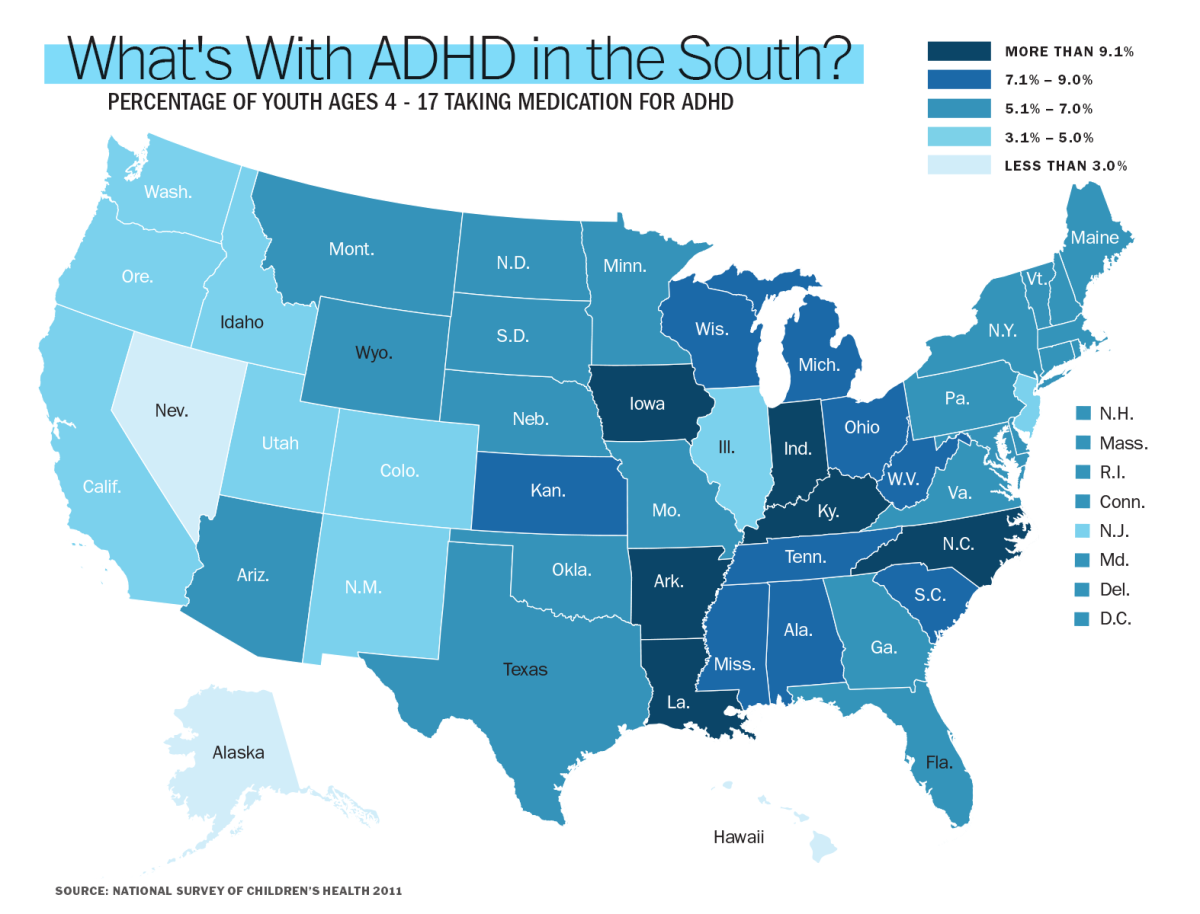
Nationally, the rates of ADHD diagnoses and medical handling are on the ascent, simply the CDC's map reveals dramatic differences betwixt states, with a prevalence of ADHD diagnosis and drug handling in the south.
What's at piece of work here? That's what Stephen Hinshaw, PhD, vice chair of psychology in the department of psychiatry at the Academy of California in Berkeley wanted to know when he teamed with Berkeley health economist Richard Thousand. Scheffler PhD, to drill down into the statistics. Here's what they plant:
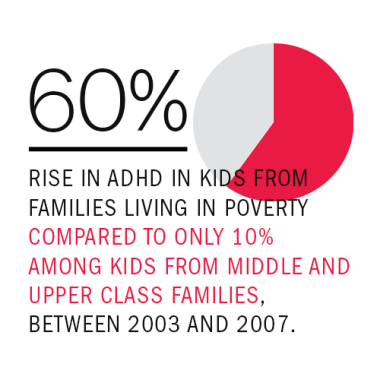
• Policy Change They traced the crash-land in ADHD diagnosis and handling to education policies implemented in the south and midwest in the 1990s and the whole country later on No Kid Left Backside was introduced in 2001. These policies punished schools, usually by cutting their funding, if they didn't raise their kids' examination scores. That meant there was a payoff if states with increased ADHD diagnoses, says Hinshaw, particularly among the poor where they rose an amazing 60% between 2003 and 2007, compared to simply ten% amongst kids from center and upper form families. For one thing, a diagnosis tin lead to treatment that could help underachieving students do better in the classroom and, every bit a effect, increment mean test scores.
• Funding But "the more nefarious explanation," says Hinshaw, is that school districts option upwards a get out of jail costless card by having more than children diagnosed with ADHD. Thanks to a Supreme Courtroom Ruling, kids with ADHD are considered special education students whose test scores are not taken into account when a district's functioning is tallied. Having a lot of students diagnosed with ADHD allows the districts to simply drib the scores of their lowest achievers and not lose any funding. "This was what policy people call an unintended consequence," says Hinshaw. "I'chiliad sure the authors of No Child Left Backside didn't plan for this to happen."
• Poverty Many of the districts with the highest rate of ADHD are also districts with a lot of folks living within 200% of the poverty line. Once ADHD was considered a "white middle class boy" diagnosis," says Hinshaw, but since the 1990s, it has been a reimbursable condition nether Medicaid, the federal health insurance program for the poor. However, Medicaid covers ADHD assessments and medication, but not other therapies which may as well explain why rates of drug treatment are likewise on the rise. "As a event of all these policies and laws, Medicaid kids are more likely to accept an ADHD diagnosis than eye class kids for the beginning fourth dimension in history," says Hinshaw. There may exist other environmental factors that account for the statistical rise in ADHD, says Hinshaw, "simply right now, this is as close to a smoking gun equally we've got."
Choosing the Correct Drug
Parents frequently go through a period of trial and mistake as they and their doctor endeavor to find the right medication for their child. Here are some of the pros and cons of the most pop ADHD drugs
Stimulants
How they work: Increase levels of the neurotransmitter dopamine in the brain, stimulating cognition, attention and focus
• Ritalin and Methlphenidate-based Drugs
Ritalin LA, Ritalin SR, Methylin, Metadate, Focalin, Concerta, Quillivant XR
Duration: Lasts from iii-four hours (Ritalin) to x hours (Quivallent XR)
Pros: Constructive in 755 of the people who take it. The drug can be safely used in preschoolers. Newer, longer-lasting, once-a-day medications are available, including Ritalin LA, Ritalin SR, Metadate CD and Metadate ER, Concerta, Daytrana (a patch); Focalin XR, (a capsule filled with pellets that tin can be opened and hidden in nutrient), and Quivallent XR, (a liquid)
Cons: May be addiction-forming; can cause slowed growth, loss of appetite and weight, irritability, and surge of ADHD symptoms (called rebound symptoms) as it wears off. Ritalin and generics must exist taken 2 to 3 times a twenty-four hour period. They tin can increase anxiety and tics and are not equally constructive in toddlers equally they are in older children; greater take a chance of side effects for younger children. Very rare side effects include sudden death.
• Adderall (mixed amphetamine)
Adderall XR, Vyvanse
Elapsing: iv-5 hours (Adderall) to 10-12 hours (Adderall RX, Vyvanse)
Pros: Effective in individuals who need a stronger drug than Ritalin, particularly teens and adults. Adderall XR and Vyvanse clothing off more slowly with fewer rebound symptoms. Vyvanse is a once-daily pill for children half-dozen years and older.
Cons: May be habit-forming; tin can cause slowed growth, loss of appetite and weight, irritability, and restlessness. Very rare side effects include sudden death.
•Dexedrine, Dextrostat, Dexedrine Spansul
Duration: iv-five hours (Dexedrine, Dextrostat) to v-10 hours (Dexedrine Spansul)
Pros: Approved for children under half-dozen, slightly longer-acting than Ritalin. Dexedrine Spansul can eliminate mid-day doses in young children.
Cons: May be habit-forming and has the aforementioned potential side effects equally other stimulants (meet above.)
Nonstimulants
How they work: Increases dopamine circulating in the blood by decreasing blood force per unit area. Intuniv and Tenex may exist combined with a stimulant for children who are very hyperactive, aggressive, and emotionally explosive.
• Strattera
blood pressure level drugs Intuniv (fourth dimension-released guanfacine; Tenex), Clonidine, Catapres, Kapvay; and some antidepressants
Duration: Up to 24 hours
Pros: These nonhabit-forming drugs tin can be an alternative to stimulants, though they're unremarkably used with them. They target specific symptoms like farthermost hyperactivity and aggressiveness. Blood force per unit area drugs can also aid children sleep and may care for feet, nervous habits and tics, and bedwetting.
Cons: Tin be sedating. Clonidine drugs take cardiac furnishings that may make them inappropriate for children. Antidepressants can increase suicidal thoughts and actions in children and teens.
Choosing Some other Treatment
How much of a role does environment or nutrition play in ADHD? It's difficult to tell, but some experts recommend a couple of strategies that tin can augment if not replace medication. But call up: in that location'due south no magic bullet. ADHD is non curable.

Nutrition:
• Cut downwardly on artificial food-coloring In 2007, a placebo-controlled British report found that a variety of common nutrient dyes and the preservative sodium benzoate cause some children to become much more than hyperactive and distractible. The dyes are banned in U.k., but notwithstanding allowed in U.Due south. foods, though the FDA has acknowledged that the artificial colorings are linked to beliefs problems in children with ADHD and those who don't take it.
• Try an elimination nutrition In a 2011 study, nearly ii-thirds of the 27 children with ADHD who followed a strictly supervised elimination diet—which ultimately limited their menu choices to rice, meat, vegetables, pears, and water—over the course of nine weeks showed significant comeback in ADHD symptoms and oppositional defiant disorder, a design of angry, irritable behavior which oftentimes occurs with ADHD.
• Accept Supplements Some specialists recommend omega-3 fatty acid supplements which, according to a 2014 German report of 95 children, helped bolster working retentivity. But the supplements had no effect on other symptoms of ADHD such as attention and the speed at which the children were able to process information.
• Switch to Organic ADHD has recently been linked to pesticides used on most of the U.S. food supply. An all-organic diet may reduce exposure by as much as 90%.
Brain Training:
• Endeavour Neurofeedback Neurofeedback is a blazon of biofeedback that uses demonstrations of brain activity to teach cocky-regulation. A person can run across in real time how his feelings or thought processes change his physical responses. A 2013 written report institute that children in nineteen Boston-area elementary schools who did forty sessions with a video-game-like program chosen Play Attention had increased attending spans, reduced hyperactivity, and fewer impulsive behaviors. The effect lasted for upwards to half dozen months.
During neurofeedback, children wear headgear with electrodes that measure their brain waves, and play games on the computer aimed at altering those brain waves to make them calmer. They might, for instance, have to focus on making dolphin dive into the bounding main. After repeating the game endless times, the kids learn how to amend control their encephalon waves, with some lasting effects.
Programs such as Play Attention are available for use at abode, merely they're expensive—roughly $180 a month. In some cases, federal funding may be available.

Torso Preparation:
• Exercise: Like stimulants, exercise tin help increase dopamine levels in the basal ganglia—shown to be abnormal in ADHD kids—past increasing the number of receptors on nerve cells, at least in animal studies. Exercise also increases norepinephrine, the brain chemical linked particularly to ADHD's fidgetiness. And it seems to have a calming influence on the amygdala, the "reptile" role of our brains that tin can make a kid discomfited by new experiences and more emotionally volatile.
• Go Outside: Several studies by two researchers at the University of Illinois plant that children with ADHD who play in outdoor green spaces like a park have milder symptoms than those who play indoors or in an urban setting.
Additional Resources
Parenting—or working with—a child with ADHD can be exhausting and tricky. Luckily, help is at hand. Hither's where to go for back up, advice and as much information equally yous can utilise.
Helpful Organizations and Information
• Children and Adults with Attention Deficity/Hyperactivity Disorder is a national, nonprofit organization that provides educational activity, advocacy and support for people with ADHD. Information technology produces both print and web-based educational textile on ADHD, reports on new enquiry, and sponsors community back up groups effectually the country.
• This website on ADHD from the National Institutes of Mental Health which gives basic information about the condition and upwardly-to-the-minute news on scientific inquiry
• The Centers for Illness Control and Prevention's site on ADHD contains basic information about the condition, plus research, information and statistics, information on conferences and preparation, scientific articles, and ordering information foe gratuitous printed materials; there are also state information profiles and maps
• Charlotte Englehard blogs nigh the trials and tribulations—and joys—of raising a son with ADHD.
• Ruth Hughes, PhD, CEO of CHADD, writes well-nigh ADHD both as an proficient in the field and the mother of a child with ADHD; occasional guest experts contribute.
• Brenda Nicholson was diagnosed at the age of 42 when she was having her children evaluated for ADHD. She is a life bus specializing in adults with ADH.
• ADDitude is a magazine for parents and others dealing with ADHD. Information technology contains, articles, blogs, data on treatment, parenting, associated learning disabilities, as well as a resource guide and online support and advisory groups.
Source: https://time.com/growing-up-with-adhd/
0 Response to "Im Not a Hot Mess More Like Red Again Slow Meme"
Postar um comentário